Monday, December 3, 2012

How Soccer (Tournaments) Explain HIV Counseling and Testing


Get tested for HIV and earn your soccer team points in the tournament. Simple concept, amazing results.
 

GRS Alexandra’s 2nd HIV Counseling and Testing (HCT) Soccer Tournament, Sat Nov 17th, Altrek Sports Facility, Alexandra


It was a day of craziness: 300 soccer players, 24 teams, testing and media partners—the real deal for the first soccer tournament I've ever organized. In the twelve hours that the tournament took place last Saturday I got to sit down once-- to get tested for HIV—a break in the day which was anything but relaxing. But it was also a day of fun, laughter, excitement and inspiration that proved to shine above all the logistics, mishaps, sunburns and running around— things in the end that made that sunny Saturday in Alex a day I won’t soon forget!

As event coordinator, the weeks leading up to the tournament were filled with match fixtures and communicating with partners, staff orientations and material gathering. Then last Saturday came, where everything I had been preparing finally got to show itself. If anything (or anyone) had a problem, I was the one to solve it.
Talking things over with Skillz Coach Mlungisi, in line for HIV Counseling and Testing (HCT)

And so the day came. The goals didn’t arrive on time, neither did the referees, or the teams for that matter. Our testing partners were unaware of our targets for the day and the venue we held the tournament at had been double-booked by its coordinator, forcing us to work out a deal with the development workshop that arrived at the same time we did.
                
All these hurdles, in the end, were shaded in how successful the tournament had been by the end of the day. 300 soccer players and 24 teams, men and women, from all over Alexandra participated in our tournament for the day, all ready and willing to participate in GRS activities, learn about Medical Male Circumcision (MMC), and get tested for HIV in addition to playing soccer—really cool stuff.
                
Soweto Intern (and roomie) Matt discussing tournament strategies with Skillz Coach Fanyana

The event was spread out through the fields at Altrek Sports facilities in East Bank Alexandra, right across the river from the traffic-filled streets of downtown Alexandra. Each team, guided by a Grassroot Soccer Coach, were provided with a schedule for the day filled with match fixtures, Grassroot Soccer Activities, info sessions for MMC, and HIV testing. Teams would not only be awarded points for wins during their matches but also for participating in our health awareness activities:


Match Win = 3 Points ; Match Draw = 1

Team participates fully in a GRS activity (Find the ball, HIV Attacks, Breakaway from HIV) = 3 points
Player Referred for Medical Male Circumcision (MMC) = 1 Point
             
Player Tested for HIV = 1 Point


What was really incredible were the players and coach’s excitement for participating in all the events we had on the day, not just for the points but because they were interested in gaining information that could help the community of Alex in the fight against HIV and to be a healthier community as a whole. Ayanda, a 14 year old player for Moroka Lions FC, is a perfect example of this and found himself in GRS’s newsletter for the December Edition:
Ayanda sprained his ankle in his team’s first match of the day. Instead of sulking in the corner, Ayanda spent the entire day on Skillz Coach Fox’s back, being piggybacked from GRS Activities and MMC info sessions to his team’s matches. At the end of the day, Ayanda was found (still on Coach Fox's back) heading towards the HCT tents; through all the pain, Ayanda had decided to test for HIV. Upon asking him why he decided to test despite his injury, Ayanda replied emphatically with a big smile, “I wanted to know my status”!
Skillz Coach Fox carrying and injured Ayanda to the tents for HCT
The day closed out in the best way possible. The women’s final was a hard-fought battle and the men’s final ended in a penalty shoot-out (see video below). Matt, my roommate and intern from Soweto, happened to be the GRS liaison for the champion team, Superstars...


 ...Coincidence?

Saturday, October 27, 2012

How Soccer Explains HIV Prevention and the Peace Corps


Last month I got a call from James Donald, our GRS Country Director, asking if I’d like to help out with a training of Peace Corps Volunteers (PCVs) in our new Peace Corps Skillz curriculum up in Polokwane. To this, I replied, “Definitely! Where’s Polokwane?”

So I hopped in a car with co-workers KK, Doug and Tony and began driving north from Jo’burg to Limpopo Province, one of the most rural parts of South Africa, in order to help train others in our HIV-prevention curriculum—I was excited, to say the least.

Sure I'll go to Limpopo! Where's that?!?!

Now, when thinking of a Peace Corps training in Polokwane, I imagined a once-in-a-lifetime experience: arriving in a dusty village and working out of an old, beat-up schoolhouse for a couple days. Needless to say I was a little surprised (and just a bit disappointed) to find out that Polokwane was the capital of Limpopo Province and that we were conducting the training out of a conference room in a 4-star hotel.

Grassroot Soccer (GRS) has been partnered with the Peace Corps for several years now and, in my opinion, provides GRS with the best ability to spread its Peace Corps Skillz curriculum to rural parts of the world that we otherwise wouldn’t be able to access.

An introductory video to Peace Corps Skillz

For three days, we delivered a great training to some very dedicated PCVs and their community counterparts (local partners), going through our GRS practices--essentially soccer-inspired lessons and activities.
 Peace Corps member Lebo dribbling two "sexual partners" during Breakaway from HIV

Facilitator Doug (remember him from the video?) leading an energizer with Peace Corps Volunteers

While Doug and Tony led the PCVs through most of the curriculum, I was fortunate enough to be able to facilitate some activities including our “elevator pitch” lesson. The lesson allowed the PCVs and community counterparts to practice talking to different people (a kid, a principal, President Obama, etc.) about the GRS curriculum.

What I found really cool about the training was that we not only got to certify PCVs but their community counterparts as well. To be able to teach people from remote areas about HIV-prevention, many who were hearing this info for the first time, was pretty amazing.


 Head Facilitator and GRS Master Coach Tony leading the group through material on HIV prevention


At the end of the training, I was so pleased to hear some of the ways the PCVs and their community counterparts described the curriculum: “interactive”, “fun”, “informative”, “inspiring”—all things that made me incredibly happy with the work I’ve been doing.

And so, from there, we made the trip back to Johannesburg, leaving our mark on Limpopo, an area I hadn't even known about two days previously--pretty awesome stuff.

Sunday, October 21, 2012

How Soccer Explains...The Crooked Cop


Driving in Downtown Jozi can be hectic: people running red lights, minibus taxis swerving if front of you, goats peppering the road (in Alexandra, at least…). In all this chaos, which I can manage at times, there also exists the most frustrating and sometimes costly thing: police road blocks.

There seems to be two types of road blocks- the real ones and the fake ones. The legal ones, usually demarcated by traffic cones and 5 or 6 cops, are legitimate set-ups done in order to see if drivers actually have their licenses, etc.—these are fine by me and ensure safe driving.

The illegal ones, set up by a couple cops trying to get bribes out of people, can be pretty frustrating.
The other day on my way to work I was at a red light—all was normal. The light turned green, I turned left, and found myself on the next street only to be staring down a cop who was pointing right at my car and giving me that “pull over” look.

I obliged, thinking I’d show my passport and be on my way. Turns out this isn’t the case. “You went through that red light back there”, he said in a cheeky manner. In my head I think my brain exploded, you kidding me?

I try to explain to him that I didn’t but he wouldn’t budge, in the end telling me that I’d have to pay him a R1000 find ($120 USD). I began to realize that this wasn’t a real road block but rather just a cop looking for a big bribe.


Just as I was about to begin to talk my way out of a ticket, a helping hand reached in to assist me: soccer.
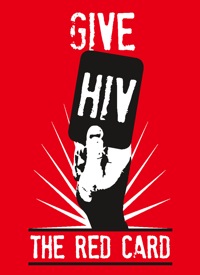
“Is that a red card?” The cop asked curiously, pointing at the Red Card for HIV-risk in the window near my rear-view mirror. “Are you a referee? I love soccer.”

“Why yes it is and I am, kinda…” I said, gleaming that the cop got sidetracked from his original mission. “It’s a risky behavior red card—I work and play soccer with kids in Alexandra. It’s pretty cool”. I showed him the GRS t-shirt I was wearing as proof.

The cop was pretty interested, seemingly about the soccer more than anything else. He continued to tell me that he was a fan of the Kaizer Chiefs—I told him I was a Pirates supporter and we had a quick laugh.

“ I will give you a verbal warning for today,” he said in the end.

Just another example that soccer is universal and you can use it as a tool in any scenario- whether teaching HIV prevention or getting out of a phony ticket.